Evals are the product
An enterprise assistant is only as good as the last change you didn't break. How to turn real failures into a test suite, keep an LLM judge honest, and stop shipping on vibes.
In the early months of most assistant projects I've seen, the release process for anything touching the model is a person. Someone changes a prompt, swaps a retrieval parameter, or moves to a newer model, and before it goes out a senior engineer opens a chat window and asks it twenty questions they happen to remember. If the answers feel right, it ships.
That works for a demo. It does not work for an assistant serving many customer organisations, each with its own documents, its own vocabulary and its own idea of what a good answer looks like. It especially does not work when the person doing the checking is also the person who wrote the change and badly wants it to be fine.
This post is about how to replace that ritual with an evaluation practice, and why I think the eval suite is the most valuable thing an assistant team owns. More valuable than the prompts, more valuable than any single model choice. Models get replaced every few months. The record of every way the assistant has ever been wrong is what lets you replace them safely.
Why "it seemed fine" stops working
Three things change once an assistant has real users.
First, the long tail shows up. Twenty remembered questions cover the cases you already thought about. Real users ask in two languages, paste half a table, refer to "the circular from last week" and expect the assistant to know which one. Most failures live in questions nobody on the team would have thought to type.
Second, changes interact. A prompt tweak that makes answers more concise also makes the model less likely to cite sources. A retrieval change that helps one customer's policy documents hurts another customer's meeting minutes. You cannot see these trade-offs by asking twenty questions; you can only see them by asking two thousand and looking at the distribution.
Third, the people who care are not engineers. When a customer's admin says "it used to answer this properly", you need to be able to say which change broke it, when, and whether it is fixed. "We think it's better now" is not an answer an enterprise customer accepts twice.
Golden sets come from failures, not imagination
The most common mistake I see is teams writing eval questions from scratch. Someone sits down and invents a hundred "representative" queries. They are always too clean. They read like the questions the team wishes users asked.
A good golden set is built almost entirely from things that actually went wrong. Every thumbs-down, every support ticket, every "that's not what I meant" from a customer admin is a candidate. A feedback pipeline like the one I described for air-gapped deployments doubles as an eval factory: each triaged failure arrives with the conversation, the retrieved chunks, the tool calls and the model version already attached.
Turning a failure into a test case is a short, deliberate step:
- Reproduce it. Replay the conversation against the version that failed and confirm the bad answer comes back. If it doesn't reproduce, it isn't a test yet.
- Write down what good looks like. Not a perfect reference answer, which is brittle, but the facts that must appear, the sources that must be cited and the things that must not be said.
- Tag it. Tenant, language, capability (retrieval, tool use, refusal, formatting) and the root cause from triage. Tags are what let you slice results later.
- Scrub it. Replace names and identifiers before it leaves the tenant's environment. The case keeps its shape; it loses anything personal.
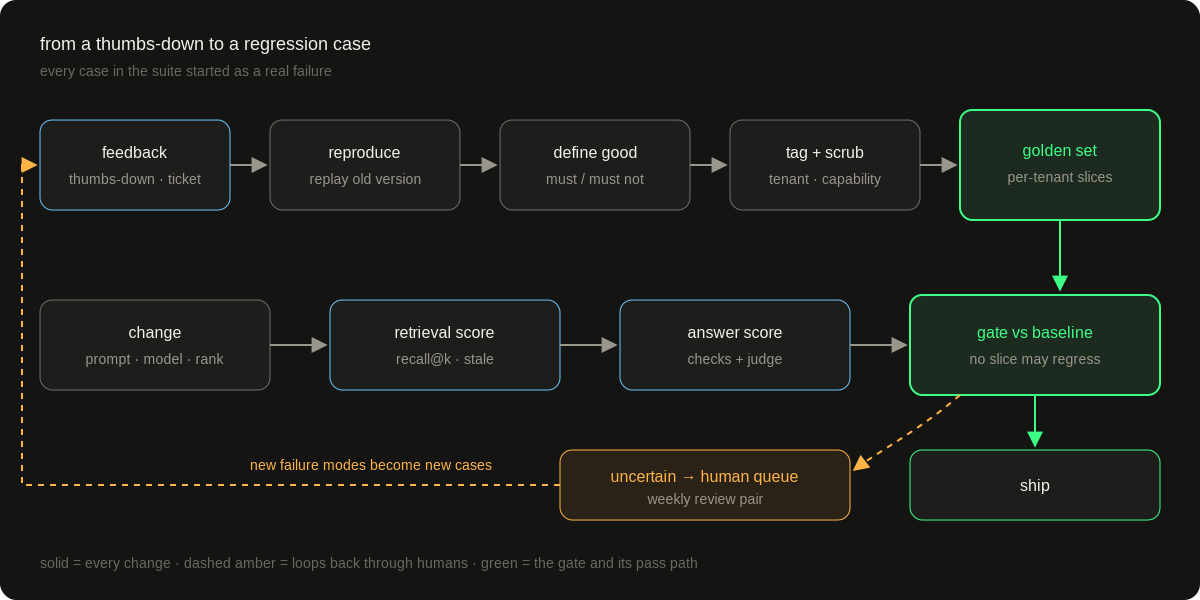 Every case in the suite starts life as a real failure. The gate runs the whole suite before anything ships.
A case might look like this. The structure matters more than the format; YAML works well because non-engineer reviewers can read it without help.
id: procurement-threshold-017
tenant: tenant-04
language: ar
capability: retrieval
source: feedback/2026-03-11/thumbs-down
must_include:
  - "the approval threshold changed in the 2025 revision"
  - cite: "procurement-policy-v7.pdf"
must_not_include:
  - "the threshold in v5"          # the stale answer it used to give
  - any_uncited_figures
question: >
  What is the current approval threshold for direct purchases,
  and who signs off above it?
notes: >
  Retrieval returned v5 and v7; model preferred the older,
  longer chunk. Fixed by recency boost in ranking.
The must_not_include list tends to be the most useful field. Most regressions are not the
assistant failing to say the right thing. They are the assistant confidently saying the old wrong
thing again.
Separate retrieval from generation
A bad answer has two possible parents: the retriever handed the model the wrong material, or the model did something poor with the right material. If you only score final answers you cannot tell which, and you end up tuning prompts to compensate for a ranking bug.
So score every case twice.
| Layer | Question it answers | Metrics to track | Cost to compute |
|---|---|---|---|
| Retrieval | Did the right chunks reach the model? | recall at k, rank of first relevant chunk, stale-document rate | cheap, deterministic |
| Generation | Given those chunks, was the answer right? | must-include coverage, citation accuracy, forbidden-content rate, judge score | expensive, partly model-graded |
| End to end | Would a user be satisfied? | pass rate per tenant and capability, human spot-check agreement | most expensive |
Retrieval metrics are boring and wonderful. They are deterministic, fast and impossible to argue with. When a retrieval change drops recall for one tenant from the high eighties to the low seventies, nobody needs a meeting to decide whether that is bad.
Generation metrics are where it gets interesting, because for most of them you need a model to grade a model.
Keeping the LLM judge honest
An LLM judge is a second model that reads the question, the retrieved context, the answer and the rubric, then returns a verdict. It is the only practical way to grade thousands of free-text answers on every change. It is also biased in ways that are easy to miss if you never check.
The biases to watch for, roughly in the order people tend to discover them:
- Length bias. Longer answers score higher even when the extra length is padding. A prompt change that makes answers much longer can look like a quality win until a human reads them.
- Position bias. In pairwise comparisons the judge prefers whichever answer comes first. Swapping the order changes the verdict on a noticeable share of cases.
- Self-preference. When the judge and the assistant are the same model family, the judge likes answers that sound like itself.
- Rubric drift. Vague rubric words like "helpful" mean different things on different days. Concrete checks, such as "cites the document that contains the figure", are far more stable.
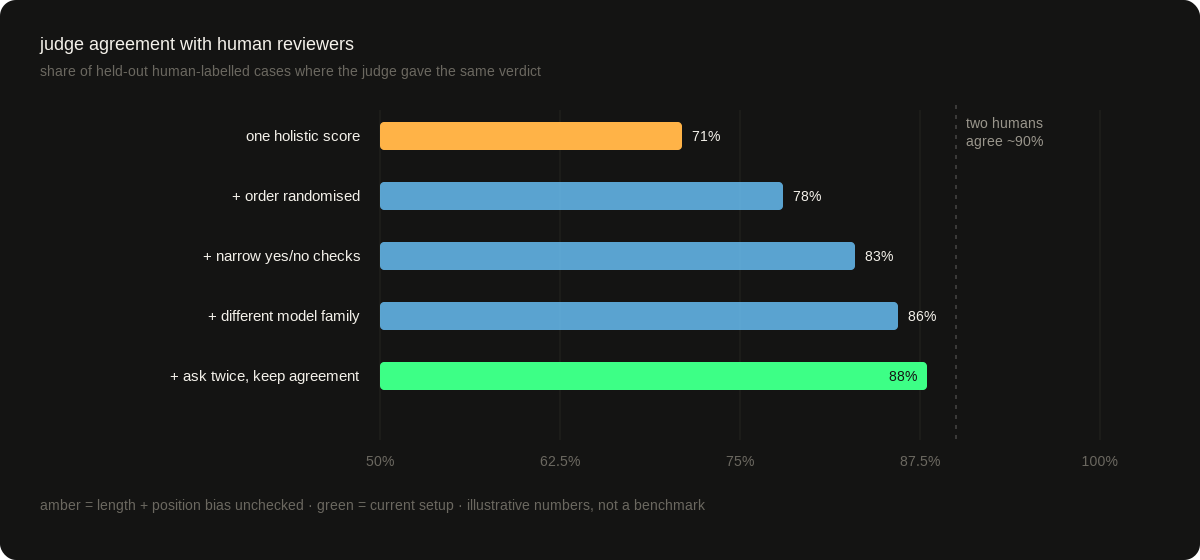 Calibrating the judge against human labels. Illustrative numbers, not a benchmark.
The fixes are unglamorous. Break the judge's job into narrow yes-or-no checks instead of one holistic score. Randomise order and run pairwise comparisons both ways, counting only verdicts that hold. Use a different model family for judging than for answering. And keep a few hundred human-labelled cases aside purely to measure the judge itself, re-running that calibration every time the judge prompt or model changes.
CHECKS = [
    "Does the answer state every fact listed in MUST_INCLUDE?",
    "Is every number in the answer supported by a cited chunk?",
    "Does the answer avoid everything listed in MUST_NOT_INCLUDE?",
    "Does the answer cite at least one of the EXPECTED_SOURCES?",
]

def judge(case: Case, answer: Answer, chunks: list[Chunk]) -> Verdict:
    results = {}
    for check in CHECKS:
        # narrow yes/no questions; ask twice with shuffled context, keep only agreement
        a = ask_judge(check, case, answer, shuffle(chunks, seed=1))
        b = ask_judge(check, case, answer, shuffle(chunks, seed=2))
        results[check] = a if a == b else "uncertain"
    return Verdict(
        passed=all(r == "yes" for r in results.values()),
        uncertain=[c for c, r in results.items() if r == "uncertain"],
        detail=results,
    )
The uncertain bucket is important. Anything the judge can't agree with itself on goes to a
human queue rather than being silently counted as a pass or a fail.
The gate: nothing ships without running the suite
Once the suite exists, the next step is obvious and usually takes longer than it should: make it a gate. Every change that can affect answers runs the full suite in CI before it can merge. That means prompt edits, retrieval parameters, chunking changes, tool descriptions, model upgrades, and the dependency bump nobody thinks of as model-related until it changes the tokenizer.
Compare against the current production baseline rather than against an absolute bar. An absolute bar invites arguments about what "good enough" is. A relative bar asks a simpler question: did this change make anything worse?
def gate(candidate: Results, baseline: Results) -> GateResult:
    failures = []

    # 1. no previously passing case may start failing in a must_not_include check
    for case_id in baseline.passing & candidate.failing_forbidden:
        failures.append(f"{case_id}: regressed into a known-wrong answer")

    # 2. no capability or tenant slice may drop more than the tolerance
    for slice_key in baseline.slices:
        drop = baseline.pass_rate(slice_key) - candidate.pass_rate(slice_key)
        if drop > TOLERANCE.get(slice_key.capability, 0.02):
            failures.append(
                f"{slice_key}: pass rate down {drop:.1%} "
                f"({baseline.pass_rate(slice_key):.1%} -> {candidate.pass_rate(slice_key):.1%})"
            )

    # 3. retrieval recall is deterministic, so any drop needs a reviewer
    if candidate.recall_at_10 < baseline.recall_at_10:
        failures.append("retrieval recall dropped; needs explicit sign-off")

    return GateResult(passed=not failures, reasons=failures)
Two rules make a gate livable. First, a failing gate can be overridden, but only with a written reason that lands in the release notes, so trade-offs are explicit rather than accidental. Second, the suite has to run in under twenty minutes. A gate that takes two hours gets skipped the first time someone is in a hurry, and then it is not a gate any more.
Per-tenant suites
A single global suite hides the thing customers care about most: their own experience. An overall pass rate can go up while one customer's goes down, and that customer will not be comforted by the average.
So slice the suite by tenant, and give each tenant cases that only matter to them: their document formats, their terminology, the acronyms that mean something different there than anywhere else. When onboarding a new customer, building its first fifty cases belongs in the onboarding plan, alongside connectors and permissions. The best source is the customer's own team in the first two weeks, writing from the questions their pilot users actually ask.
This also changes the conversation with customer admins. Instead of "is the assistant good?", you can show them their slice, the cases in it, and the trend over the last ten releases. When they report a problem, the fix comes with a new case in their suite, and they can watch it go green.
Humans stay in the loop
Automated evals do not replace people reading answers. They decide where people should read.
A weekly review by a rotating pair works well: a sample of random production conversations, everything the judge marked uncertain, and every case where the judge and the deterministic checks disagreed. That review does three jobs. It catches failure modes the suite doesn't cover yet, which become new cases. It measures whether the judge is drifting. And it keeps the whole team close to what users actually experience, which is easy to lose once you have dashboards.
Dashboards people actually read
The impressive dashboards are usually the ones that die: dozens of metrics, trend lines for every capability, heatmaps by tenant and language. They look great in a review and nobody opens them twice.
The one worth building answers a single question per row: what moved since the last release, and for whom? Each row is a slice — a tenant, a capability or a language — with its pass rate now, its pass rate at the last release, and the cases that flipped. Click a flipped case and you see the question, both answers side by side, the retrieved chunks for each and the judge's reasoning. That last part matters. A number going down starts an argument; two answers side by side usually ends it.
Put the suite's own health on the same page: how many cases exist per tenant, how many were added this month, how many the judge marked uncertain. A suite that stops growing is a suite that has stopped learning from production, and that is worth noticing before it shows up as a quality problem.
What changes
The biggest change is not quality, although quality goes up. It is speed.
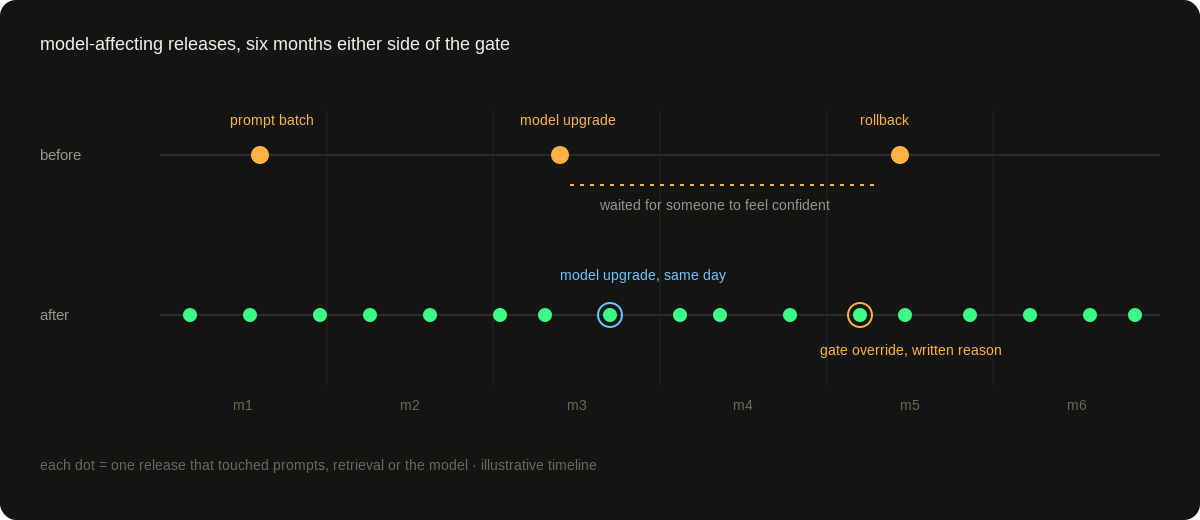 Before a gate, model changes wait for someone to feel confident. After it, they wait for the suite. Illustrative timeline.
Without a suite, a model upgrade is a project. Someone has to find time to test it, nobody trusts the testing, and upgrades slip for weeks because the downside is unknown. With a suite, a new model version is a pull request. Run the suite, read the slices that moved, decide. Prompt changes go from a monthly batch to something you ship whenever they are ready.
The suite also makes teams more honest. Changes that everyone is sure are improvements often turn out to be neutral or slightly worse once measured across every tenant. Without the numbers they ship anyway, and the team congratulates itself.
What I'd recommend
- Start the suite in week one. Even twenty cases with a dumb string-match grader save months of release-by-feel. The infrastructure is easy to grow; the habit is hard to start late.
- Store everything at answer time. Retrieved chunks, tool calls, model version, prompt version. Reproducing a failure from three weeks ago without that context is guesswork.
- Measure the judge before trusting it. An uncalibrated judge happily rewards longer answers, and some early "improvements" turn out to be exactly that.
- Give customers their slice early. Showing a customer its own eval trend does more for trust than any demo.
None of this is novel. It is the same discipline as any regression test suite, applied to a system whose outputs are fuzzy. The difference is that with an assistant, there is no other way to know what you shipped.