What four hundred interviews taught me
Notes from 400+ technical interviews at Meta, Dizart and AI71: which stages actually predict a good first year, how debriefs go wrong, and the mistakes I made along the way.
I have sat on the interviewer side of the table a little over four hundred times. About a hundred of those were at Meta in London, across software and enterprise engineering. Some were at Dizart, where I built a distributed engineering team from nothing. Most — three hundred and counting — have been at AI71, where we went from a handful of people to a team of twenty building an enterprise AI platform.
That's enough interviews to have strong opinions, and enough mistakes to know some of those opinions were wrong. This is the version I'd give a new hiring manager over coffee.
The one question every stage should answer
An interview loop is an expensive prediction machine. You're spending maybe ten to fifteen hours of your team's time, plus a similar amount of the candidate's, to predict one thing: will this person do good work here in their first year?
Every stage should earn its place by improving that prediction. Most loops I've seen contain at least one stage that doesn't. It stays because it has always been there, or because it feels rigorous, or because the interviewers enjoy running it.
When I look back at the people I've helped hire and how their first year went, the stages sort themselves out quite clearly.
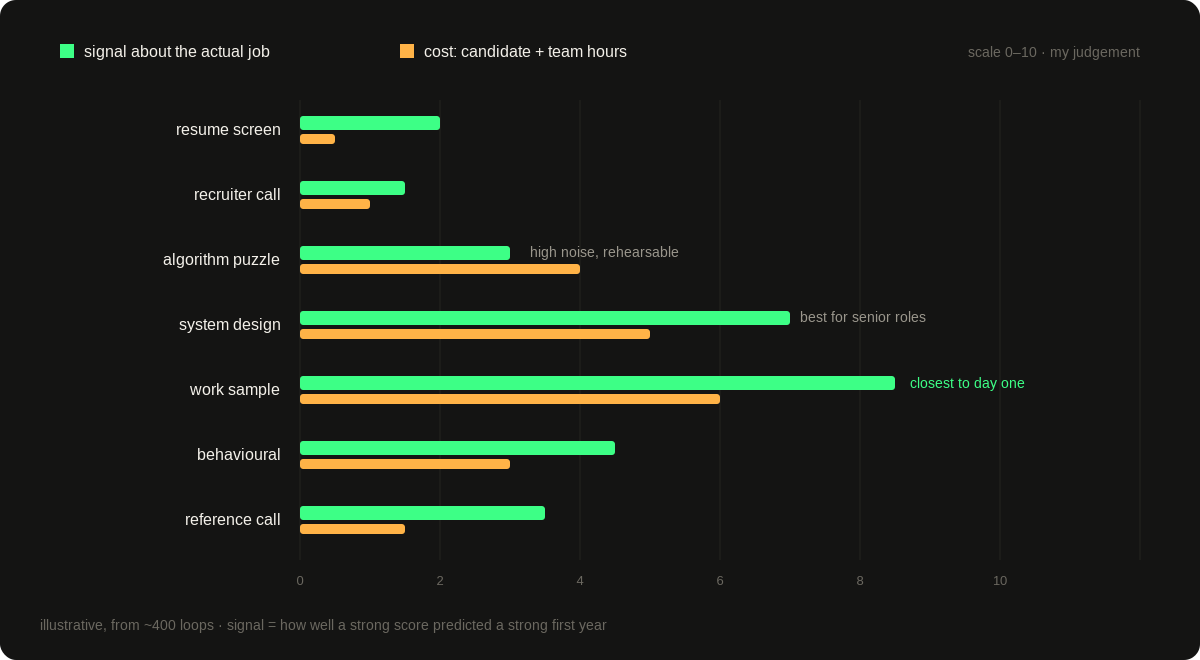 Work samples carried the most signal per hour in my experience; puzzle rounds the least.
What each stage actually tells you
Resume screen. Low signal, very cheap. It's good for one thing: filtering out clear mismatches in seniority or domain. It's terrible at spotting talent, because resumes reward people who are good at writing resumes. I've stopped reading them for "impressive" and started reading for specifics. "Improved performance" tells me nothing. "Cut p99 latency on the order service from 900ms to 120ms by moving fan-out off the request path" tells me the person knows what they did.
Recruiter or hiring-manager call. Mostly about logistics and mutual interest. Its real value is selling, not filtering. Good candidates have options; the first conversation is where they decide whether you're worth their time.
Algorithm puzzles. This is the controversial one. In my experience they have the worst signal-to-cost ratio of any stage. They are rehearsable — a candidate who spent two months grinding practice problems will outperform a better engineer who didn't. They test a narrow skill under artificial pressure. I've seen excellent production engineers freeze on a graph problem they would have solved in ten minutes with a coffee and a search engine. I still use a light coding exercise to confirm someone can actually write code, but I no longer treat it as the main event.
System design. Strong signal for senior roles, weak for juniors. A good design interview isn't about drawing the "right" architecture. It's about watching how someone handles constraints changing under them. I'll often introduce a new requirement halfway — "this now has to run inside the customer's network with no internet access" — and the interesting part is what they do next.
Work sample. The highest signal I've found. Give the candidate something close to real work: a small codebase with a bug and a feature request, a design doc to review, a production incident timeline to analyse. It costs more to build and to grade, but it's the closest thing to watching someone on day one.
Behavioural. Medium signal, highly dependent on the interviewer. Done well — specific questions, follow-ups, looking for evidence — it's valuable. Done badly, it's a vibe check that rewards confident storytellers.
Reference calls. Underused. A ten-minute call with a former manager, asking specific questions, has caught more problems for me than any other stage. "Would you hire them again?" followed by a pause is very informative.
Rubrics: write down what good looks like
The biggest single improvement I've made to any hiring process is writing a rubric before the first candidate is interviewed. Not after. Not "we'll calibrate as we go."
A rubric forces the team to agree on what they're looking for. Without one, each interviewer grades against their own private idea of a good engineer, which is usually "someone like me."
Here's a trimmed example of what one looks like for a platform engineer:
role: senior platform engineer
scale: [1-no, 2-lean-no, 3-lean-yes, 4-yes]
dimensions:
  - name: system design
    weight: 3
    four: >
      Names the failure modes before being asked; trades
      cost against reliability explicitly; changes the design
      cleanly when a constraint changes mid-interview.
    two: Draws a reasonable diagram but can't say where it breaks.
  - name: code in a real codebase
    weight: 3
    four: Reads before writing; fix is small and tested.
    two: Rewrites working code; no test for the bug found.
  - name: operating in production
    weight: 2
    four: Has owned an incident end to end and can say what changed after.
  - name: working with customers
    weight: 2
    four: Can explain a trade-off to a non-engineer without hiding it.
evidence_required: true  # a score without a quote or example is discarded
The highlighted lines are the part that matters most. Each score needs a description of what that level looks like, in observable behaviour. "Strong system design skills" is not a rubric. "Names the failure modes before being asked" is.
The last line is the rule I enforce hardest: every score must come with evidence — a quote, a specific moment, a piece of code. A score without evidence gets thrown out.
Debriefs without anchoring
For years, the debriefs I sat in went the same way. Everyone joins a call. Someone — usually the most senior person, sometimes the most confident — goes first. "Strong no for me." The next person, who had been leaning yes, now says "yeah, I had some concerns too." By the end, there's a unanimous decision that was really one person's opinion, repeated four times.
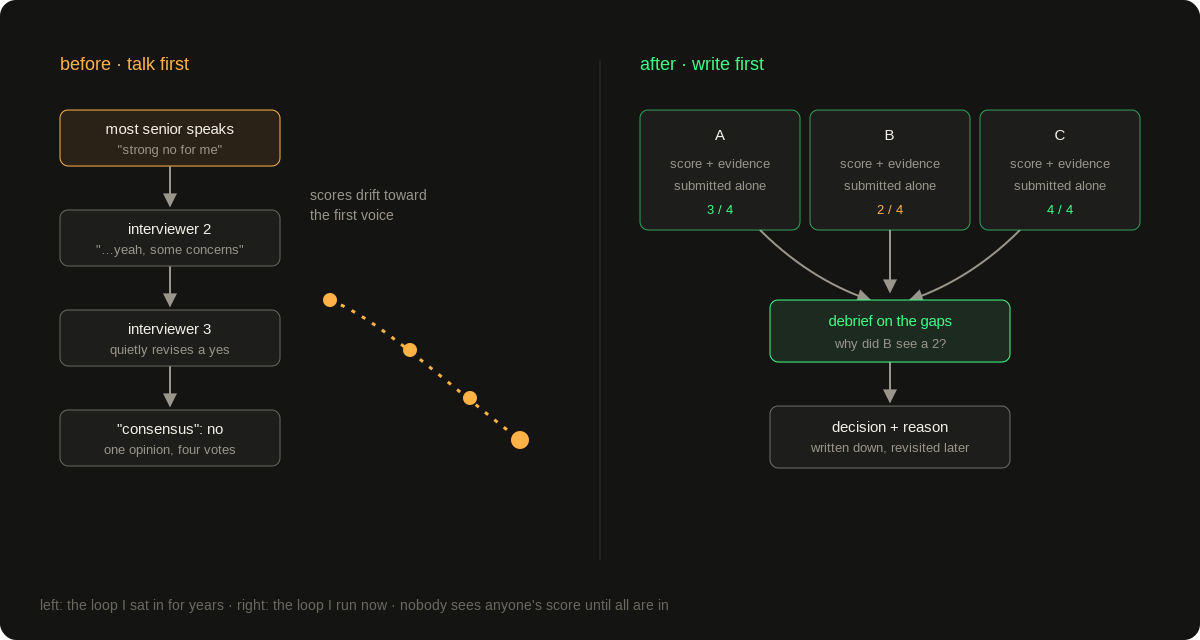 Anchoring drags every score toward the first voice. Independent written scores fix most of it.
The fix is simple and boring:
- Every interviewer submits their score and evidence in writing before the debrief. Nobody can see anyone else's until all are in.
- The debrief starts with the disagreements. If three people gave a 3 and one gave a 2, we spend the time on why the 2 happened. Often that person saw something real. Sometimes they asked a badly framed question. Either way it's the most useful conversation in the loop.
- The hiring manager speaks last. If I talk first, everyone knows what I think, and the rest of the discussion is people agreeing with their manager.
- The decision and its reason are written down. A short paragraph. Six months later, we look back at a sample of decisions and check whether the reasons held up.
Point four is what turns hiring from a series of gut calls into something that improves. You can't get better at predicting if you never check your predictions.
Calibrating interviewers
Even with a good rubric, interviewers drift. Some become hawks: they never give a 4, because nobody is ever quite good enough. Some become doves: they never give a 1, because they feel bad. Some sit on the fence, giving only 2s and 3s so they're never clearly wrong.
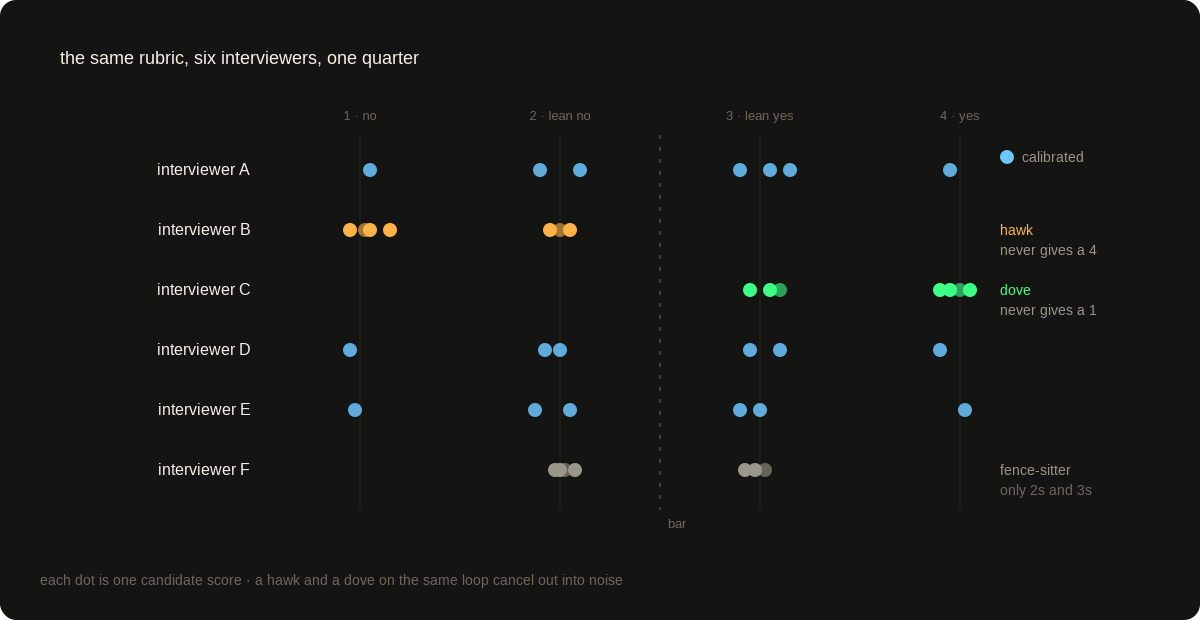 A hawk and a dove on the same loop cancel out into noise. Looking at the distribution makes the drift visible.
Once a quarter I pull each interviewer's score distribution and look at it with them. It's not a performance review; most people are genuinely surprised by their own pattern. A few habits help:
- Shadow, then reverse-shadow. New interviewers watch two loops, then run two with an experienced interviewer watching them. Only then do they interview alone.
- Compare scores to outcomes. Not just "did we hire them" but "how did their first year go." This is slow feedback, but it's the only kind that matters.
- Rotate questions. Interviewers who ask the same question for two years start grading the candidate's answer against their own perfect answer, which they've refined in their head a hundred times. Fresh questions keep everyone honest.
Hiring for forward deployed roles
At AI71, a large part of my hiring has been for forward deployed engineers — people who build the platform while sitting with government clients. The technical bar is the same as for any senior platform engineer. What we add on top:
| What we look for | How we test it |
|---|---|
| Listening before solving | A role-play where the "client" describes a symptom, and the real cause only appears if the candidate asks follow-up questions. |
| Saying no with a reason | A request that would break a policy. We want a clear, polite no and an alternative. |
| Debugging unfamiliar systems | A broken setup with logs from a system they've never seen. We watch the method, not the answer. |
| Writing for two audiences | A short written exercise: the same change, explained once to a client executive and once to an engineer. |
The role-play has been the most predictive addition. Strong engineers who jump straight to a solution — usually a good solution to the wrong problem — tend to struggle on site. The ones who ask three questions before proposing anything tend to thrive.
Mistakes I made
Four hundred interviews means plenty of wrong calls. The ones that taught me the most:
Hiring for the interview, not the job. Early on, I passed candidates who were excellent at interviews. Fast, articulate, polished. A few of them were much weaker at the slow, unglamorous parts of the work: reading old code, writing tests, following up. The interview rewarded speed; the job rewarded care.
Mistaking confidence for competence. Related, but distinct. Some people present uncertain answers with total confidence. Others hedge everything, even when they're right. I now ask "how sure are you?" and treat a calibrated answer as a positive signal.
Letting the loop get too long. At one point a loop had seven stages. Good candidates dropped out, because they had offers elsewhere that took two weeks, not five. The extra stages added almost no signal. Five well-designed stages beat seven mediocre ones.
Not closing the feedback loop. For years I never checked whether my scores predicted anything. When I finally did, I found my system design scores tracked first-year performance well, and my "culture" scores barely tracked anything at all. I dropped that dimension and replaced it with specific behaviours.
Lowering the bar under pressure. When a team is drowning, it's tempting to hire the "pretty good" candidate now rather than wait a month for a great one. Every time I did this, it cost more than the month would have. A weak hire doesn't just underperform; they take up time from the people you were trying to relieve.
What I'd tell a new hiring manager
- Write the rubric before the first interview, with observable behaviours for each level.
- Replace puzzle rounds with work samples wherever you can afford to build them.
- Collect written scores independently. Debrief the disagreements. Speak last.
- Keep the loop short. Every stage should be able to say what it predicts.
- Check your predictions against first-year outcomes, at least once a year.
- Never lower the bar because you're busy. Being busy is temporary; a bad hire is not.
None of this is new. Most of it is in books that were around long before I started. The hard part isn't knowing it — it's doing it consistently, on the hundredth loop, when you're tired and the team is behind. That's where the process earns its keep: it makes the right thing the default, even on a bad day.